

Getting an internship is hard. You constantly hear that you need one if you want a good job after graduation, but nobody actually shows you how to get an internship. Then the advice starts coming from every direction. Apply to 100 companies. Get your GPA up to a 4.0. Go to every career fair. It’s all about who you know. Don’t worry about it until junior year. Half of it contradicts the other half, and you’re left wondering where to even start.
I’m here to give you a straight answer. This post lays out exactly what to do to land the internship, based on what I did and what I’ve watched other students do. It worked for me, and I’ve seen it work for plenty of people around me.
My name is Gavin Gapinski. I’m a junior accounting major and finance minor at University of Central Florida (UCF), and next summer I’ll be a Corporate Accounting Intern at Fidelity Investments in Boston. Two years ago that would have sounded crazy. I spent my freshman year at community college where I didn’t do any networking, and I had no idea about what I wanted to do, let alone how to get there.
So this isn’t advice from someone who had it all figured out. It’s the exact process that got me my offer, broken down by what year of college you’re in, plus what I’d do differently if I could start over. I’ll use accounting as my example since that’s my field, but these steps work in pretty much any industry.
Here’s the biggest lesson up front: your resume gets you considered, but networking is what gets you the internship. Most students put all their energy into applications and barely talk to anyone at the companies they’re applying to. Flip that.
The short version
Here’s how to get an internship in 8 steps:
- Join 2-3 student organizations and work toward a leadership role.
- Polish your resume and LinkedIn profile.
- Pick your industry and 3-5 companies you really want to work for.
- Message 10-20 professionals at those companies on LinkedIn a week.
- Turn those messages into 15-minute coffee chats, and end each one by asking who else you should talk to.
- Get to know the recruiters before applications open.
- Apply the day postings go live and practice your interview answers with the STAR method.
- Accept the offer and thank everyone who helped you get there.
The steps are the same no matter what year you’re in. The timeline is what changes. Read the playbook first, then jump to your year.
The 8-Step Internship Playbook
Every year of college uses these same eight steps. Read this part first, then skip to your year for the timeline.
Step 1: Join student organizations and go for a leadership role
Getting involved on campus is the fastest way to build your resume when you don’t have work experience yet, and it is where employers show up so it’s a great place to start. Companies sponsor student organizations, send professionals to speak at meetings, and recruit straight out of them.
Start with the professional organization for your major. Every major (especially business majors) have Registered Student Organizations (RSOs) or clubs you can join. Recruiters want to hire the applicant who is involved on campus, building their soft skills, and in a leadership role. In accounting and finance, that means groups like your school’s accounting and finance societies and business clubs. Involvement in these groups really stand out on your resume.
Don’t just join. Show up, volunteer for a committee, and run for a position when elections come around. A leadership role gives you real resume bullets and real stories to tell in interviews. Two organizations where you’re actually involved will do more for you than eight where you’re just a name on the roster.
Step 2: Polish your resume and LinkedIn
Your resume and LinkedIn are the first things people check after they meet you, so get them ready before you start networking.
Resume:
- Keep it to one page.
- Start every bullet with an action verb and add numbers wherever you can. “Planned three chapter events with 50+ attendees” beats “helped plan events.”
- Include every job, even if it has nothing to do with accounting. Sales, customer service and waiting jobs all show you can work with people.
- Have your career center review it, then ask a professional to look at it once you’ve built some relationships.
- Starting from scratch? Follow my 6-week plan to build a resume that gets interviews.
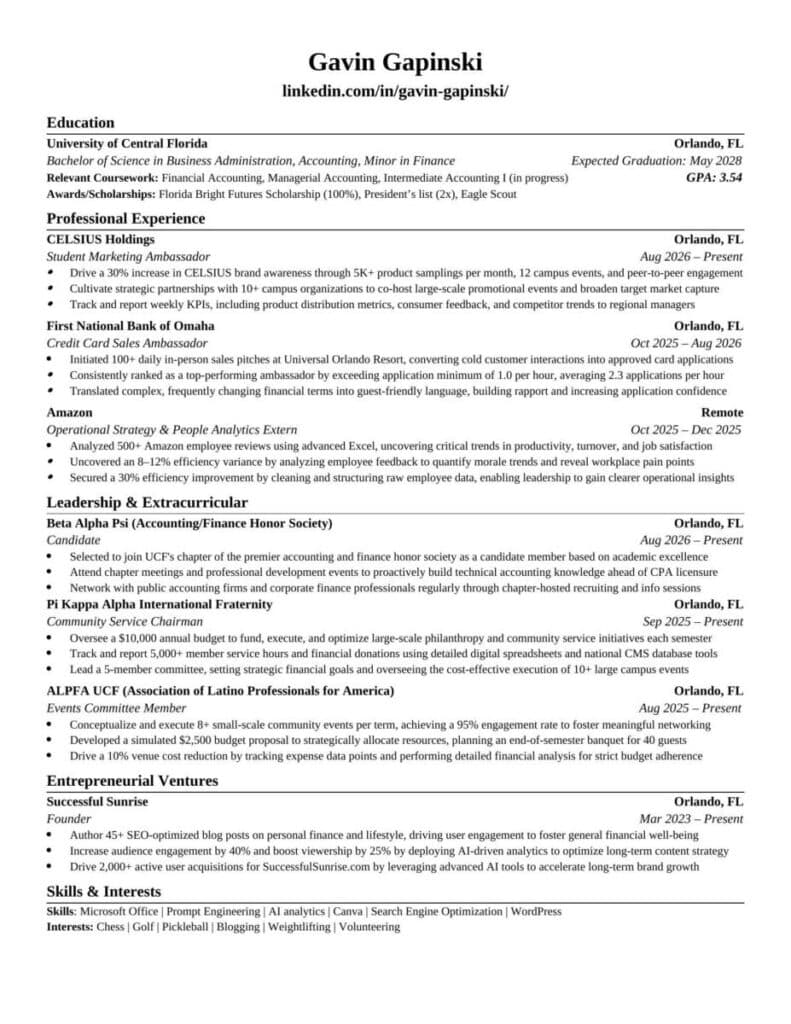
Here is my resume for reference:
LinkedIn:
- A professional headshot (a friend with a good phone camera works fine)
- A headline that says more than “Student at UCF,” like “Accounting Student at UCF | Community Service Chair at PIKE | Aspiring CPA”
- A short About section written in first person
- Every organization, leadership role and job from your resume
- A custom URL (linkedin.com/in/yourname)
Step 3: Pick your industry and 3-5 target companies
You can’t network with every company, and you shouldn’t try. First, narrow down your industry and the kind of role you want. In accounting, for example, there are three main paths:
- Public accounting: audit, tax or advisory work at the Big 4 (Deloitte, EY, KPMG, PwC) or mid-size firms
- Corporate accounting: working in-house for one company, like Fidelity
- Government and forensic accounting: agencies like the IRS, the FBI or your state government
Whatever your major, map out your field the same way. Then pick 3-5 companies you’d be excited to work for. Make a simple spreadsheet with each company, when its internship applications usually open, and every person you’ve talked to there. That spreadsheet becomes your whole networking plan.
Step 4: Message 10-20 professionals on LinkedIn (the real sauce)
This is the step most students skip, and it’s the one that matters most.
Find 10-20 people across your target companies a week. Mix it up: alumni from your school (the Alumni tab on your school’s LinkedIn page lets you filter by company), people a few years out of college, managers, and recruiters. People who were in your shoes recently are usually the quickest to reply.
Send a connection request first. Once they accept, send a short message like this:
Hi [professionals Name], thanks for connecting! My name is [Your name] and I’m a [your major and your school]. I’m really interested in learning more about your role as a [job title] at [Company].
I noticed [one specific thing from their profile], and that really stood out to me.
Would you be open to a quick 15-minute call or coffee chat sometime in the next couple of weeks? I’d really appreciate hearing about your experience.
Thanks, [your name]
A few rules that make this work:
- Personalize that one line. It’s the difference between a reply and getting ignored.
- Don’t ask for a job or a referral. You’re asking to learn, not asking for a favor.
- Follow up once. If they don’t answer in about a week, send one friendly nudge, then move on.
- Expect some silence. Not everyone will reply, and that’s normal. That’s why you send 10-20.
Step 5: Nail the coffee chat (and always ask for the next name)
Once someone says yes, prepare like it’s a mini interview, because it kind of is.
Before the call, read their LinkedIn, look up recent news about the company, and write down 5-6 questions. Here are some that work well:
- What does a normal day look like in your role?
- What made you choose [Company], and what’s kept you there?
- What do the best interns on your team do differently?
- What does the internship recruiting process look like at [Company]?
- What do you wish you’d known when you were in college?
During the call, stick to the 15 minutes you asked for unless they offer more time. Let them do most of the talking and take notes.
Before you hang up, ask the question that keeps your network growing: “Is there anyone else you think I should connect with?” Most people are happy to pass along a name or two, and an intro from someone inside the company gets a much warmer response than a cold message.
After the call, send a thank you message within 24 hours that mentions something specific they said. Add them to your spreadsheet. When you apply, send a quick update like “Just applied to the summer internship, thanks again for the advice!” It keeps you on their radar without being annoying.
One senior manager I had a coffee chat with told me the best thing I could do was say yes to things and take every opportunity I could. That advice stuck with me, and it’s a big reason this whole process worked.
Step 6: Get to know the recruiters
Professionals can tell you about the work. Recruiters decide who gets an interview. You want both on your side.
- Meet campus recruiters at career fairs, info sessions and organization meetings, or find them on LinkedIn by searching “[Company] campus recruiter” plus your state.
- When you meet one in person, connect on LinkedIn that same day with a note reminding them where you met.
- Use the same coffee chat approach. Recruiters are busy, so keep it short and come with good questions about their process.
The goal is simple: when your application lands on their desk, they already know your name.
Step 7: Apply on day one and practice your interviews
Turn on job alerts on your target companies’ career sites, Handshake and LinkedIn so you know the second a posting goes live. A lot of companies review applications as they come in, so applying early means you’re competing while there are still spots open.
Most internship interviews are behavioral, and the best way to answer behavioral questions is the STAR method:
- Situation: Set the scene.
- Task: Explain what you were responsible for.
- Action: Walk through what you specifically did.
- Result: Share what happened, with numbers if you have them.
Write out 6-8 stories ahead of time that cover leadership, teamwork, conflict, a failure, and a time you went above and beyond. Practice them out loud until they sound natural instead of memorized. Your career center can run a mock interview with you, and it’s worth doing at least once.
Be ready for “Why this position?” and “Why our company?” This is where your coffee chats pay off, because you can talk about real conversations you had with people who work there.
Step 8: Accept the offer and say thank you
When the offer comes, accept it (or ask for a deadline if you’re waiting to hear back from other companies). Then go back and thank every person who helped you along the way. Those same people are your network for the full-time offer, so keep those relationships going.
That’s the whole playbook. It’s simple, but it’s definitely not easy. Here’s how the timeline changes depending on your year.
How to Get an Internship as a Freshman
If you’re a freshman, you have the biggest advantage of anyone reading this: time. Most freshmen won’t land a traditional internship, and that’s okay. Your job this year is to build the foundation so you’re ready when recruiting starts, which is sooner than most people think.
Your freshman year game plan
- Fall: Join 2-3 organizations and actually show up. Set up your LinkedIn and write your first resume.
- Spring: Get on a committee. Go to your first career fairs and networking events. Do 2-3 low-pressure coffee chats with upperclassmen, recent alumni or professors just to practice.
- Summer: Get a job, any job. Look for short programs that some companies run for freshmen and sophomores, and start figuring out which industry interests you most.
- All year: Protect your GPA. Employers do look at it, especially in accounting and finance.
My freshman year (and what I’d do differently)
I spent my freshman year at community college, and I didn’t do any networking. Honestly, I didn’t even know that was something college students were supposed to be doing yet.
If I could go back, I’d change three things:
- I’d set up a real LinkedIn and start connecting with UCF accounting students and alumni before I transferred.
- I’d join a club or two at my community college so I’d show up at UCF with some leadership experience.
- I’d have a few coffee chats just to learn what accounting careers actually look like day to day.
The good news is it still worked out. If you’re at a community college, or you’re a sophomore reading this and thinking you already blew freshman year, you didn’t.
How to Get an Internship as a Sophomore
Sophomore year is when recruiting really starts in a lot of industries, and most students don’t realize it until it’s already happening. In accounting, for example, the big firms run sophomore leadership programs that work like an early pipeline into junior year internships. When I was a sophomore, almost every application I wanted went out right at the beginning of the fall semester.
Your sophomore year game plan
- Summer before sophomore year: Finish your resume and LinkedIn. Pick your 3-5 target companies and look up when their sophomore programs and internships usually open.
- Fall: Apply to sophomore programs the week they open. Start your LinkedIn outreach and aim for a few coffee chats a month. Go for a committee or officer role in your organizations.
- Spring: Keep networking. Apply for any summer roles open to sophomores, and line up a summer job as a backup.
- Summer before junior year: This is the big one. Go to conferences and recruiting events, finish your coffee chats with your target companies, and make sure the recruiters know who you are before junior year starts.
My sophomore year
I transferred to UCF my sophomore year and joined ALPFA UCF, which was honestly the best decision I’ve made in college. It put me in rooms with professionals and recruiters I never would have met on my own.
The problem was timing. By the time I got settled, most of the applications had already gone out at the start of the semester, and I wasn’t established enough to compete for them anyway. I missed that whole first wave.
So I locked in. I joined more organizations, went to every networking event I could, and took a job at Universal Studios as a credit card sales ambassador. Pitching credit cards to park guests all day taught me how to start a conversation with anyone and how to not take a “no” personally. Those soft skills made networking feel way less awkward.
The lesson: a job that has nothing to do with your major still counts. If you can talk to people and handle hearing no, you’re already ahead of a lot of applicants.
How to Get an Internship as a Junior
Junior year is when you need to be absolutely locked in. For most students, the internship the summer after junior year is the one most likely to turn into a full-time offer, and recruiting for it moves fast. Timelines depend on your industry, so look yours up early. In accounting, for example, Big 4 internship applications usually open in late August and close by late September.
That means the real work happens before junior year even starts. If you wait until applications open to start networking, you’re already late.
Your junior year game plan
- Summer before junior year: Lock in your 3-5 companies. Have multiple coffee chats at each one, make sure the recruiters know your name, and turn on job alerts.
- Late August to September: Apply the day postings go live. Send a quick note to your contacts at each company letting them know you applied.
- Fall: Interview season. Expect a phone screen and then a final round, and practice your STAR stories every week.
- No offer by winter? Don’t panic. Smaller companies often don’t follow the big-company timeline, and plenty of employers hire later in the year. Keep networking and keep applying.
How I landed my Fidelity internship
By the summer before junior year, I finally had a plan: I wanted to work at Fidelity.
I first met people from Fidelity at the ALPFA Summer Conference in Charlotte. After that, I reached out on LinkedIn and ended up having coffee chats with 6 or 7 different professionals at the firm, including a senior manager in brokerage accounting. By the time applications opened, I understood what the teams did, I had a feel for the culture, and people there knew who I was.
I applied, passed the phone screen, and made it to the final round. I logged off that final Zoom interview feeling really good about it.
Then in early November, I got the email. I wasn’t selected.
That one hurt. The hardest part of my whole search was that I didn’t have an internship on my resume from the summer before, and I was up against candidates who did. Networking got me in the door, but I was still competing against people with more experience on paper.
A few days later, I had a feedback call with the recruiter. I expected to hear what I could work on for next year. Instead, she told me another candidate had declined their offer, and she offered the spot to me.
I said yes. Next summer I’ll be a Corporate Accounting Intern at Fidelity in Boston, and I don’t think that call happens if I had applied cold. By then I wasn’t just another resume to them.
Two takeaways from my junior year:
- A rejection isn’t always final. Stay gracious, take the feedback call, and keep the relationship going. Doors reopen more often than you’d think.
- Get experience early. If you’re a freshman or sophomore, any experience you pick up now (even a non-accounting job) will make junior year way less stressful than mine was.
If You’re a Senior: Same Playbook, Full-Time Roles
Everything above still works senior year. You’re just using it to land a full-time job instead of an internship.
- If you’re finishing an internship: Treat it like a 10-week interview. Employers converted 63.1% of their 2024-25 interns into full-time hires, the highest rate in five years, according to NACE. Do great work and build relationships with the whole team, not just your manager.
- If you didn’t get an internship: Run the exact same playbook for full-time roles. Pick your companies, send your LinkedIn messages, have the coffee chats and get to know the recruiters. Plenty of smaller firms and companies hire new grads on a rolling basis, so it’s not too late.
Internship FAQ
When should I apply for internships?
It depends on your industry, so look up your target companies early. Financial services firms often open applications a year or more ahead. In accounting, Big 4 applications for the summer after junior year usually open in late August, and sophomore programs often open at the start of sophomore fall. Smaller companies may hire later.
Can freshmen get internships?
It’s not common at big companies, but some run short programs for freshmen and sophomores. Freshman year is better spent joining organizations, building your resume and LinkedIn, and practicing networking so you’re ready for sophomore recruiting.
How many people should I network with?
Start by messaging 10-20 professionals across your 3-5 target companies. Not everyone will reply. For my top company, I had coffee chats with 6 or 7 people before I applied.
What should I say in a LinkedIn message asking for a coffee chat?
Thank them for connecting, introduce yourself in one sentence, mention one specific thing from their profile, and ask for a quick 15-minute call. Keep it short and don’t ask for a job. The full template is in Step 4.
What questions should I ask in a coffee chat?
Ask about their day-to-day, why they chose the company, what makes interns stand out, and how recruiting works there. Always end with “Is there anyone else you think I should connect with?”
Can I get an internship without previous internship experience?
Yes. I didn’t have a prior internship when I got my Fidelity offer. Leadership roles, part-time jobs and real relationships with people at the company can carry you, but it makes the process harder. Get some kind of experience as early as you can.
Can transfer students get internships?
Definitely. I transferred from community college to UCF as a sophomore. Join a professional organization like ALPFA right away and start networking your first semester, and you’ll catch up faster than you think.
Start Before You Feel Ready
If you take one thing from this post, make it this: start networking earlier than you think you need to. I started late, it made junior year harder than it had to be, and it still worked out because I went all in once I figured it out.
Whatever year you’re in, you can start today. Pick one company, find one person there on LinkedIn, and send the message.
If this helped, subscribe to The Sunrise Brief, my Sunday newsletter for college students. You can also find me on Instagram (@successful.sunrise) and TikTok (@successfulsunrise). And if you’re a student with questions, connect with me on LinkedIn and send me a message. I’ll actually answer it.